

Water-based drilling fluid (WBM) additives are functional chemicals used to control rheology, fluid loss, shale stability, lubrication, and density in drilling operations.
Unlike simple chemical additives, WBM performance depends on a multi-system interaction model, where each additive supports a specific functional system:
· Rheology system → viscosifiers control hole cleaning
· Filtration system → polymers reduce fluid loss
· Inhibition system → salts and polymers stabilize shale
· Lubrication system → reduce torque and drag
· Density system → maintain wellbore pressure
Proper selection and balance of these additives determines drilling efficiency, wellbore stability, and total drilling cost.
In modern drilling engineering, water-based mud additives should not be treated as isolated products.
They operate as a coupled fluid system, where each additive influences multiple performance parameters simultaneously.
WBM performance = Rheology + Filtration + Inhibition + Lubrication + Density control
If one subsystem fails, the entire drilling fluid performance becomes unstable.
2.Types of Water-Based Drilling Fluid Additives
Additive Category | Typical Products | Primary Function |
Viscosifiers | Bentonite, Xanthan Gum | Rheology control |
Fluid Loss Reducers | PAC, CMC, Modified Starch | Reduce filtration |
Shale Inhibitors | KCl, PHPA, Glycols | Prevent clay swelling |
Lubricants | Ester Lubricants | Reduce friction |
Weighting Agents | Barite, Calcium Carbonate | Density control |
pH Modifiers | NaOH, Soda Ash | Chemical stability |
Bridging Agents | Calcium Carbonate | Lost circulation control |
Defoamers | Silicone-based | Foam suppression |
Biocides | Glutaraldehyde | Prevent bacterial degradation |
Most drilling fluid formulations combine multiple additive categories to achieve balanced drilling performance rather than relying on a single product.
Without a properly designed additive system, WBM will typically experience:
· Shale swelling and borehole collapse
· High fluid loss and formation damage
· Poor hole cleaning and cuttings bed formation
· Excessive torque and drag in deviated wells
· Unstable rheology under circulation changes
Most WBM failures are not caused by a single additive deficiency, but by system imbalance between polymer, clay, and ionic environment.
Importantly, the correct additive treatment depends on the drilling environment. A formulation optimized for a low-temperature vertical well may not perform adequately in a high-temperature, extended-reach, or highly reactive shale section.
This system controls drilling fluid flow behavior.
· Bentonite (base viscosity builder)
· Xanthan gum (high-performance polymer viscosifier)
· PAC / HEC (secondary viscosity + stability control)
· Suspends cuttings and barite
· Controls yield point (YP)
· Maintains hole cleaning efficiency
· Low viscosity → poor cuttings transport
· Over-viscosity → high torque and pump pressure
· PAC (Polyanionic cellulose)
· CMC (Carboxymethyl cellulose)
· Starch-based polymers
Polymers form a filter cake network on the formation surface to reduce filtrate invasion.
· High permeability filter cake → formation damage
· Polymer degradation → sudden fluid loss increase
The optimal fluid-loss additive should provide low filtrate volume while maintaining a thin, low-permeability filter cake without creating excessive rheological loading.
This is the most critical subsystem in reactive formations.
· KCl (ionic inhibition)
· PHPA (encapsulation polymer)
· Glycols (hydration suppression)
· Suppresses clay hydration
· Controls osmotic pressure difference
· Stabilizes shale structure
· Water influx → clay swelling → borehole collapse
· Ester-based lubricants
· Fatty acid derivatives
· Synthetic oil emulsions (WBM-compatible types)
· Reduces friction coefficient
· Improves directional drilling performance
· Prevents stuck pipe risk
· Barite (BaSO₄)
· Calcium carbonate (bridging + acid-soluble weighting)
· Controls hydrostatic pressure
· Maintains wellbore stability
· Poor suspension → barite sag → density variation
· Caustic soda (NaOH)
· Soda ash (Na₂CO₃)
· Controls polymer efficiency
· Stabilizes clay dispersion
· Prevents microbial degradation
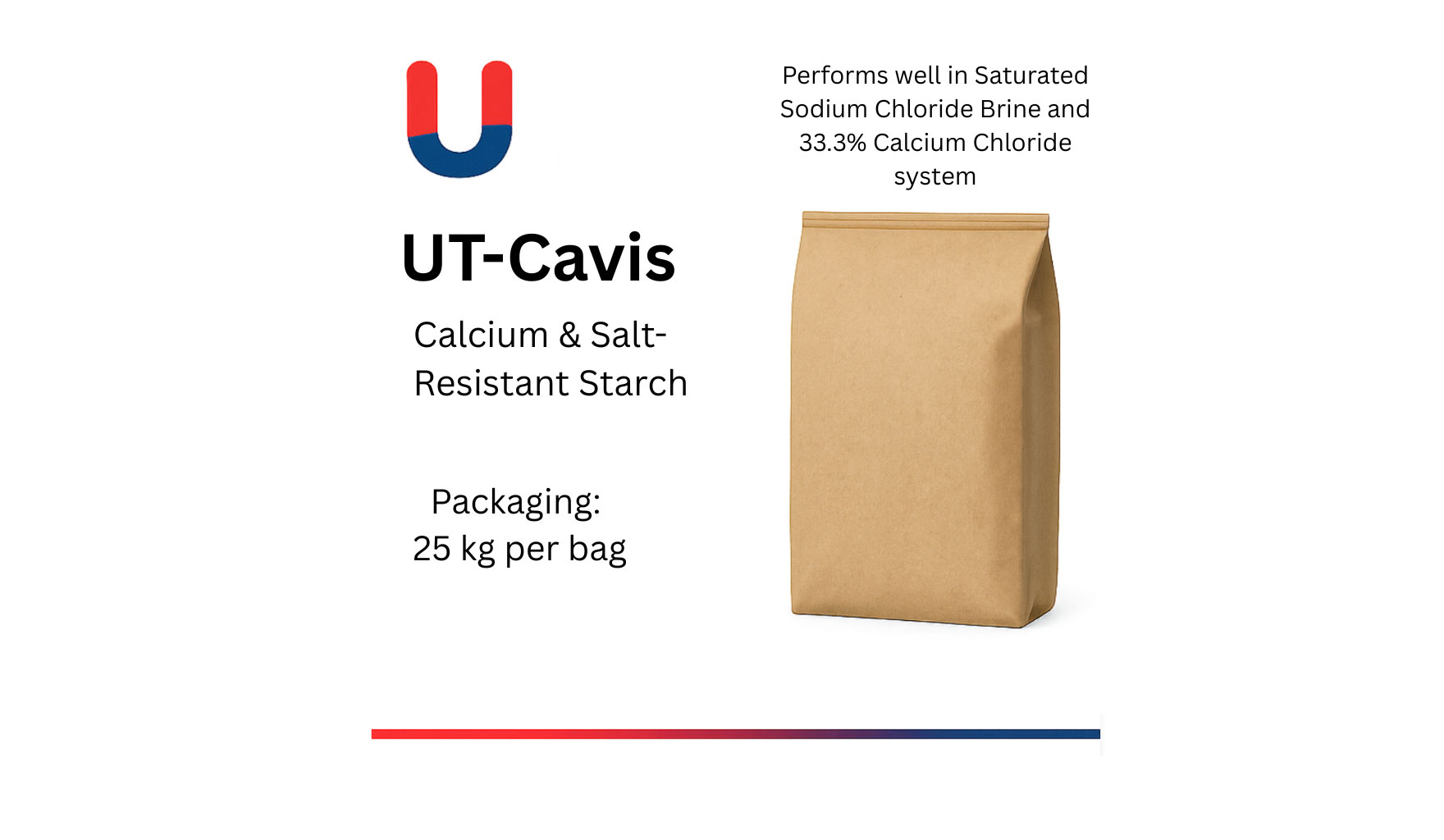
Calcium & Salt-Resistant Starch
WBM performance depends on multi-phase interaction engineering:
· Bentonite + polymers → rheology network
· Salinity (KCl) + clay → inhibition control
· PAC + solids → filtration barrier formation
· Lubricants + solids → torque reduction
WBM stability is achieved through ionic balance + polymer network + solid surface control
· Weak polymer adsorption on formation
· Poor filter cake structure
· Increase PAC / CMC concentration
· Optimize polymer molecular weight distribution
· Water penetration into clay lattice
· Ionic imbalance (low KCl concentration)
· Increase KCl / PHPA synergy system
· Optimize salinity balance
· Insufficient viscosity at low shear rate
· Adjust bentonite + xanthan gum ratio
· Optimize yield point (YP)
· High friction coefficient between solids and borehole wall
· Add lubricants
· Optimize solids size distribution
· Polymer degradation or contamination
· Rebalance viscosifier system
· Control solids loading
Selection should always be based on well condition mapping:
· Reactive shale → high inhibition system (KCl + PHPA)
· Sandstone → filtration control priority
· Vertical wells → basic rheology system
· Horizontal wells → lubrication + suspension priority
· High temperature → polymer stability control
· Low temperature → viscosity enhancement
· Formation type
· Temperature
· Pressure
· Well trajectory
· Mud density
· Expected contamination
· Drilling interval
Performance Target | Typical Evaluation |
Rheology | PV, YP, Gel Strength |
Filtration | API / HTHP Fluid Loss |
Shale Stability | Recovery / dispersion testing |
Lubricity | Coefficient of friction |
Density | Mud weight |
Thermal Stability | Aging tests |
· Viscosifier
· Fluid-loss additive
· Inhibitor
· Lubricant
· Weighting agent
· pH modifier
· Bridging agent
Additives should be tested in the complete formulation rather than individually.
· Rheology
· API Fluid Loss
· HTHP Fluid Loss
· Aging
· Lubricity
· Shale inhibition
· Contamination tolerance
· PV
· YP
· Gel
· Fluid loss
· Mud weight
· Chloride / calcium
· Solids
· pH
· Torque / drag
Parameter | WBM | OBM |
Base fluid | Water | Oil |
Stability | Medium | High |
Shale control | Chemical inhibition | Encapsulation |
Environmental impact | High | Medium |
System complexity | Moderate | High |
Cost | Low | High |
· Combine KCl + PHPA for dual inhibition mechanism
· Use polymer blends for temperature stability
· Optimize solids control to reduce chemical load
· Maintain balanced ionic strength in mud system
· Monitor rheology under dynamic shear conditions
When selecting WBM additive suppliers, evaluate:
· Lab testing (rheology + filtration)
· Shale inhibition data
· High-temperature stability reports
· Field application experience
· Formulation optimization ability
· Custom system design support
· No lab data
· Generic product claims
· No field performance validation
A well-optimized WBM system can:
· Reduce mud treatment frequency
· Improve rate of penetration (ROP)
· Minimize formation damage
· Extend drilling fluid life
· Reduce non-productive time (NPT)
Water-based drilling fluid additives are not independent chemicals but components of an integrated engineering system.
Their performance depends on the balance between:
· Rheology control
· Filtration management
· Shale inhibition
· Lubrication efficiency
· Ionic stability
A properly designed WBM system ensures stable drilling performance, reduced operational risk, and lower total well cost.
If you are experiencing:
· Shale instability
· High fluid loss
· Poor hole cleaning performance
· Unstable rheology
· Excessive torque and drag
Unitech Chemicals can support drilling fluid programs with:
· Customized WBM additive selection
· Laboratory testing and formulation optimization
· Compatibility and performance evaluation
· Technical recommendations for different formation and well conditions

Unitech Chemicals provides drilling fluid additives and chemical solutions for water-based and oil-based mud systems.
Our product portfolio includes additives for rheology control, fluid-loss control, shale inhibition, lubrication, filtration control, lost circulation control, and other drilling fluid performance requirements.
We work with drilling fluid companies, oilfield service providers, and drilling operators to help select and optimize additive systems according to formation characteristics, temperature, pressure, well trajectory, mud properties, and operational requirements.
For water-based drilling applications, our team can help evaluate additive compatibility and develop WBM treatment strategies based on specific drilling conditions.
Explore our Water-Based Drilling Fluid Additives or contact Unitech Chemicals for technical support.