

Calcium & salt-resistant starch is a modified starch used in water-based drilling fluids (WBM) to maintain fluid-loss control and low-shear rheology under high-salinity and high-calcium conditions. Unlike conventional starch-based additives that may lose effectiveness in concentrated CaCl₂ systems, calcium & salt-resistant starch is designed to work in high-CaCl₂ drilling fluids, particularly when used with xanthan gum. UTcavis from Unitech Chemicals is a calcium & salt-resistant starch developed specifically for high-concentration CaCl₂ drilling fluid systems.
Calcium & salt-resistant starch is a modified starch designed for water-based drilling fluids exposed to high concentrations of dissolved salts and calcium ions.
Starch-based additives are widely used for fluid-loss control because they can contribute to the formation of a low-permeability filter cake on the wellbore wall. However, the performance required in a conventional freshwater or low-salinity mud system is different from that required in a highly concentrated CaCl₂ drilling fluid.
In high-calcium systems, drilling fluid additives must maintain their functional performance despite elevated ionic strength and the presence of divalent calcium ions. This is particularly important when the drilling fluid must simultaneously provide filtration control, suspension, and predictable rheological behavior.
Calcium & salt-resistant starch is therefore designed for applications where conventional fluid-loss reducers may not provide sufficient performance.
Calcium chloride drilling fluid systems can provide several useful properties for challenging drilling applications, including strong inhibition and reduced shale hydration, dispersion, and swelling. These characteristics can be beneficial for maintaining shale stability and are relevant to applications such as shale gas development.
However, increasing CaCl₂ concentration also creates a demanding chemical environment for drilling fluid polymers.
In high-concentration CaCl₂ drilling fluids, conventional polymer viscosifiers and fluid-loss reducers may become less effective. The high ionic environment can affect polymer hydration and performance, making it more difficult to maintain the desired rheological and filtration properties.
A high-calcium drilling fluid can exhibit low ϕ6 and ϕ3 readings and insufficient low-shear-rate viscosity (LSRV).
Low-shear rheology is important because the drilling fluid must maintain sufficient carrying and suspension capacity at low shear rates. If low-shear viscosity is inadequate, solids can settle more easily when circulation conditions change.
Fluid-loss control is another major concern. If the fluid-loss additive cannot maintain its performance under high CaCl₂ concentrations and elevated temperature, excessive filtrate invasion can occur.
Maintaining a stable filter cake and controlling filtration are therefore important considerations when designing high-calcium WBM systems.
The primary role of calcium & salt-resistant starch in a water-based drilling fluid is filtration control.
When properly formulated, the starch contributes to the formation of a relatively low-permeability filter cake, helping limit filtrate loss from the drilling fluid into the formation.
Its value becomes more significant in high-CaCl₂ systems because the additive must continue functioning in an environment where conventional polymers may experience reduced effectiveness.
Calcium & salt-resistant starch can also be used together with xanthan gum to support the low-shear rheology of the drilling fluid.
For high-concentration CaCl₂ systems, this combination can help address several performance requirements simultaneously:
· Fluid-loss control
· Low-shear-rate viscosity
· Solids suspension
· Cuttings-carrying capacity
· Rheological stability
The exact performance depends on the complete drilling fluid formulation, additive concentration, calcium concentration, temperature, and other operating conditions.
The key difference is not simply the chemical name of the starch, but its suitability for the drilling environment.
Performance Requirement | Conventional Starch | Calcium & Salt-Resistant Starch |
Freshwater WBM | Commonly used | Applicable |
Low-salinity systems | Applicable | Applicable |
High-salinity systems | Performance may be formulation-dependent | Specifically designed for salt-tolerant applications |
High-CaCl₂ systems | May have limited effectiveness | Specifically developed for high-CaCl₂ systems |
Fluid-loss control | Depends on formulation and conditions | Designed to maintain filtration control under high-calcium conditions |
Low-shear rheology support | Limited as a standalone function | Can work synergistically with xanthan gum |
High-CaCl₂ drilling applications | Not the primary application | Target application |
This comparison does not mean that conventional starch is unsuitable for all saline drilling fluids. Rather, the selection of a fluid-loss additive should consider the actual salinity, calcium concentration, temperature, rheological requirements, and complete mud formulation.
UTcavis is a modified starch developed by Unitech Chemicals specifically for high-concentration CaCl₂ drilling fluid systems.
After more than ten years of R&D, the product was developed to address the performance challenges associated with calcium chloride drilling fluids.
When used together with xanthan gum, UTcavis is designed to generate higher low-shear-rate viscosity and support:
· Suspension capacity
· Cuttings-carrying capacity
· Fluid-loss control
· Rheological performance in high-CaCl₂ systems
The product is supplied as a light-yellow, free-flowing, non-caking powder and is available in 25 kg bags.
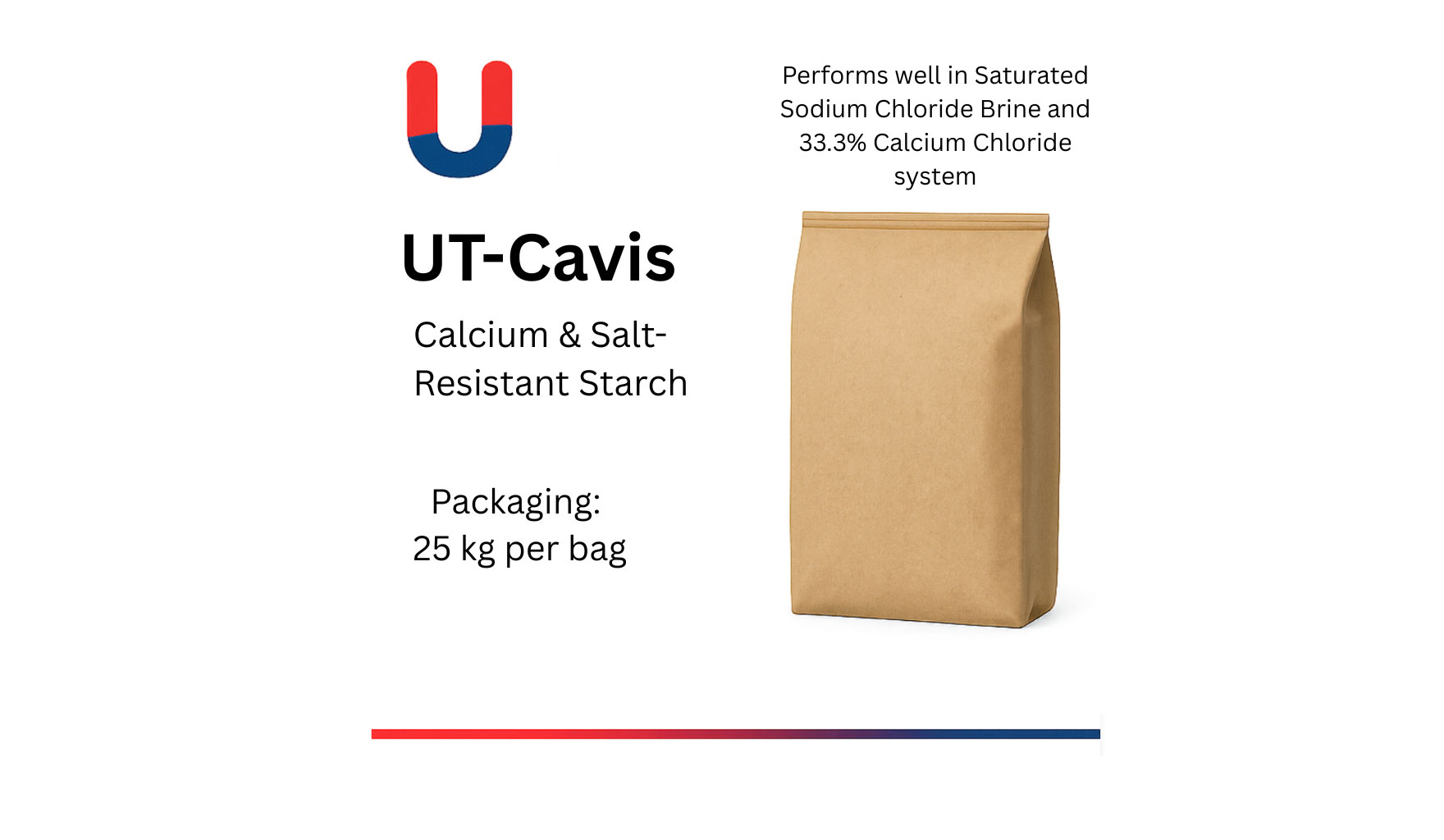
The manufacturer's product specifications include the following parameters:
Property | Specification |
Appearance | Light yellow powder, free-flowing, non-caking |
80-mesh residue | < 10% |
Moisture content | < 12% |
ϕ6 Reading | ≥ 5 |
ϕ3 Reading | ≥ 3 |
API Fluid Loss | ≤ 8 mL |
HTHP Fluid Loss | ≤ 15 mL |
The rheological and filtration specifications are based on a 33.3% CaCl₂ drilling fluid system under the manufacturer's specified test procedure.
For the specified test, the system is hot-rolled at 110°C for 16 hours, cooled to 49°C for ϕ6 and ϕ3 measurements, and then cooled to 25°C for API fluid-loss testing. HTHP fluid loss is tested at 120°C.
Actual drilling-fluid performance can vary depending on mud composition, additive concentration, temperature, salinity, and field conditions.
To evaluate UTcavis under severe calcium and salinity conditions, Unitech Chemicals conducted a laboratory evaluation using a water-based drilling fluid system containing 33.3% CaCl₂.
The test system had a specific gravity of 1.33 and included calcium chloride, xanthan gum, UTcavis, calcium carbonate particles, and magnesium oxide. UTcavis was added at 5.7 g in the tested formulation.
Component | Amount | Function |
Distilled water | 308 mL | Base fluid |
Calcium chloride (CaCl₂) | 154 g | High-calcium salt |
Duovis | 1.52 g | Rheology modifier |
UTcavis | 5.7 g | Calcium & salt-resistant starch |
CaCO₃, 40 μm | 16.5 g | Bridging / weighting material |
CaCO₃, 7.5 μm | 16.5 g | Fine bridging material |
MgO | 2 g | pH / alkalinity stabilizer |
The drilling fluid was evaluated under different thermal-aging conditions, including room-temperature baseline testing and dynamic hot rolling at 100°C, 110°C, and 120°C. The tests evaluated rheology, gel strength, API fluid loss, HTHP fluid loss, pH, and specific gravity.
The laboratory results demonstrate that the tested WBM system containing UTcavis maintained measurable low-shear rheology after thermal aging.
After 110°C dynamic hot rolling for 16 hours:
· 6 rpm reading decreased from 14 to 11
· 3 rpm reading decreased from 10 to 7
· 10-second gel strength changed from 9 to 7
· 10-minute gel strength changed from 11 to 8
At 120°C dynamic hot rolling for 4 hours:
· 6 rpm reading increased from 18 to 25
· 3 rpm reading increased from 13 to 20
· 10-second gel strength increased from 12 to 19
· 10-minute gel strength increased from 14 to 21
These results provide laboratory evidence that the tested system retained low-shear rheological characteristics across the evaluated thermal-aging conditions.
Fluid-loss control is one of the most important performance requirements for a high-CaCl₂ WBM system.
API fluid loss remained between 2.0 and 3.6 mL across the tested conditions. The lowest value was 2.0 mL in the room-temperature baseline test, while the highest value was 3.6 mL after 120°C dynamic hot rolling for 4 hours.
The reported HTHP fluid-loss results at 120°C were:
Thermal Aging Condition | HTHP Fluid Loss |
100°C hot rolling | 8.6 mL |
110°C hot rolling | 9.8 mL |
120°C hot rolling | 8.0 mL |
The lowest reported HTHP fluid loss in the evaluated conditions was 8.0 mL after the 120°C test condition, while the highest was 9.8 mL after the 110°C condition.
These results indicate that the tested UTcavis-containing WBM maintained fluid-loss control under the combined effects of high CaCl₂ concentration and elevated temperature.
The laboratory results also show relatively stable plastic viscosity across the tested thermal conditions.
The reported PV values after aging were approximately:
· 30 mPa·s at baseline
· 29 mPa·s after 100°C rolling
· 29 mPa·s after 110°C rolling
· 33 mPa·s after 120°C rolling
At 120°C, the YP changed from 58 to 59 lb/100ft² after dynamic hot rolling.
For drilling-fluid engineers, this type of rheological stability is relevant because excessive changes in viscosity and yield point can affect hydraulics, solids suspension, and hole-cleaning behavior.
Based on the product specifications and the reported laboratory evaluation, UTcavis is designed to address several challenges associated with high-concentration CaCl₂ drilling fluids.
UTcavis is specifically developed for high-CaCl₂ drilling fluid systems, where conventional fluid-loss additives may have reduced effectiveness.
Across the full test series, API fluid loss ranged from 2.0 to 3.6 mL. After dynamic hot rolling, API fluid loss ranged from 2.3 to 3.6 mL across the 100°C, 110°C, and 120°C conditions.
When used with xanthan gum, UTcavis is designed to support higher low-shear-rate viscosity, which is important for suspension and cuttings transport in high-CaCl₂ systems.
The product was evaluated through thermal-aging conditions from room temperature to 120°C, including dynamic hot rolling. The results showed that the tested system maintained useful rheological and filtration properties throughout the evaluation.
Because UTcavis is developed specifically for CaCl₂ drilling fluids, it can be considered when designing water-based mud systems where calcium concentration, filtration control, and low-shear rheology are critical.
Calcium & salt-resistant starch is particularly relevant to drilling operations involving high-salinity or high-calcium water-based mud systems.
Potential applications include:
This is the primary application for UTcavis. The product is specifically designed for high-concentration CaCl₂ systems.
CaCl₂ drilling fluids can provide strong inhibition and help suppress shale hydration, dispersion, and swelling. Calcium & salt-resistant starch can be incorporated into these systems when fluid-loss and low-shear rheology control are required.
Where formation fluids or drilling conditions introduce high concentrations of calcium ions, a calcium-tolerant fluid-loss additive may be considered as part of the WBM formulation.
The laboratory evaluation of UTcavis included thermal aging up to 120°C, making thermal stability an important part of its performance profile.
Selecting a starch additive should not be based only on its product name. Drilling-fluid engineers should evaluate the additive under the actual mud conditions.
Important factors include:
Determine the actual calcium chloride concentration and evaluate whether the additive has been tested in a comparable system.
Consider both circulating temperature and static bottomhole temperature. Thermal aging tests can help evaluate whether filtration and rheological properties remain stable.
For high-CaCl₂ systems, review ϕ6 and ϕ3 readings rather than relying only on 600-rpm or 300-rpm measurements.
Both API and HTHP fluid loss should be considered when filtration control is important, particularly for high-temperature drilling applications.
Because UTcavis is designed to work synergistically with xanthan gum, the performance of the complete polymer system should be evaluated rather than testing the starch in isolation.
The final performance depends on the entire drilling fluid formulation, including salts, polymers, bridging materials, weighting agents, pH control, temperature, and additive concentrations.
Parameter | Product Specification | Reported Laboratory Result |
ϕ6 | ≥5 | 11 after 110°C / 16 h |
ϕ3 | ≥3 | 7 after 110°C / 16 h |
API Fluid Loss | ≤8 mL | 3.4 mL after 110°C / 16 h |
HTHP Fluid Loss | ≤15 mL | 9.8 mL after 110°C / 16 h aging, tested at 120°C |
The laboratory results shown above come from one reported 33.3% CaCl₂ WBM evaluation and should not be interpreted as a universal performance guarantee. Product specifications and laboratory results are based on their respective test conditions. Actual field performance may vary with mud formulation and operating conditions.
Unitech Chemicals has developed UTcavis specifically for high-concentration CaCl₂ drilling fluid applications.
The product combines a specialized starch-based fluid-loss-control approach with low-shear rheology support when used with xanthan gum. Its product specifications and laboratory evaluation provide technical reference data for engineers evaluating calcium-resistant additives for WBM systems.
For drilling-fluid programs involving high CaCl₂ concentration, high salinity, fluid-loss control, or low-shear rheology requirements, UTcavis can be evaluated as part of the complete mud formulation.
If you are working with a high-CaCl₂ or high-salinity water-based drilling fluid, Unitech Chemicals can provide UTcavis samples and technical information for laboratory evaluation.
When requesting a sample or technical recommendation, please provide your approximate CaCl₂ concentration, drilling temperature, mud density, current fluid-loss performance, and the additives currently used in your formulation.
This information helps our technical team recommend a more relevant test formulation.

High-concentration CaCl₂ drilling fluids can offer important inhibition and shale-stability advantages, but they also create demanding conditions for conventional drilling-fluid polymers.
Calcium & salt-resistant starch provides a specialized approach to fluid-loss control in these systems. When combined with xanthan gum, it can also support low-shear rheology, suspension, and cuttings-carrying capacity.
UTcavis was developed specifically for high-concentration CaCl₂ drilling fluids. In a reported 33.3% CaCl₂ laboratory system, the product maintained measurable low-shear rheology and provided API fluid loss of 2.0–3.6 mL across the tested thermal-aging conditions, while HTHP fluid loss at 120°C ranged from 8.0 to 9.8 mL.
For drilling-fluid engineers working with high-calcium WBM systems, these results provide a useful technical reference when evaluating calcium & salt-resistant starch as part of a complete drilling-fluid formulation.