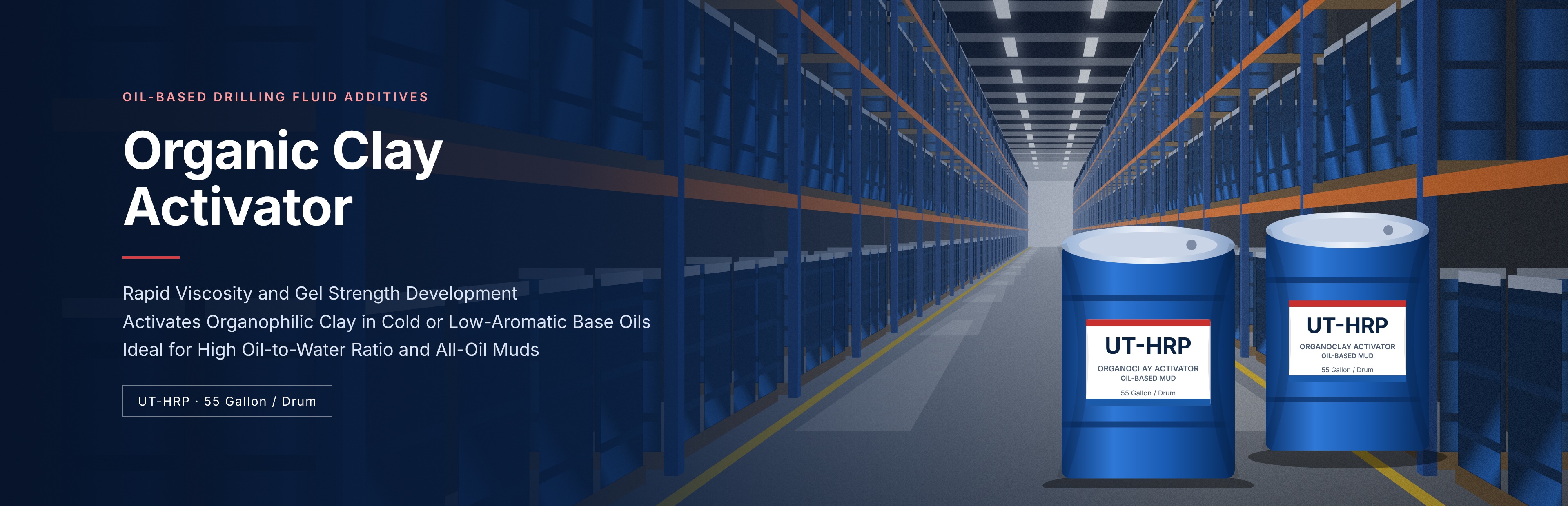
UT-HRP is an organophilic clay activator that helps oil-based drilling fluids rapidly develop viscosity and gel strength. It is particularly useful when organophilic clay fails to develop sufficient rheological properties, such as yield point (YP) and gel strength, immediately after mixing. This can occur under one or more of the following conditions.
- Limited mixing intensity. The mixing equipment may be unable to provide enough shear to disperse and activate the organophilic clay during mud preparation.
- Insufficient mixing time. The clay may have too little time to develop its full viscosifying and gel-building effect, resulting in weak initial rheology. It typically takes several downhole circulation cycles for the clay to develop its full effect. Operators may compensate by adding too much clay during mixing, which can lead to excessive viscosity once the fluid has circulated.
- Low aromatic content in the base oil. Field experience shows that organophilic clay builds viscosity and gel strength much faster in base oils with higher aromatic content, such as certain diesel oils, than in low-aromatic mineral oils.
- Low base-oil temperature during mixing. The base oil may be very cold when the organophilic clay is added.
- Low base-oil viscosity and a high oil-to-water ratio. Fluids with ratios such as 95:5 or even 100:0 (all-oil mud) can have very low viscosity and insufficient solids suspension capacity.
Under these conditions, UT-HRP is particularly well suited for use with organophilic clay. By optimizing the drilling fluid formulation, UT-HRP and the clay work together to achieve the required fluid properties.
UT-HRP consists primarily of polyamide compounds. The product information describes it as having no adverse effects on health or the environment.
Product Specifications
| Item | Specification |
|---|
| Appearance | Clear orange liquid |
| Density at 20°C | 0.95–1.0 g/cm³ |
| Flash point (open cup) | ≥ 110°C |
| Solubility | Soluble in organic solvents |