

Drilling fluids, commonly known as drilling muds, are essential to oil and gas drilling operations. Similar fluid systems and additives are also used in geothermal, water well, mining, and horizontal directional drilling (HDD) applications.
Beyond simply circulating through the wellbore, drilling fluids perform multiple critical functions, including transporting drill cuttings, maintaining wellbore stability, controlling formation pressure, cooling and lubricating drilling equipment, and minimizing formation damage.
To achieve these functions under varying geological and operational conditions, drilling fluids are formulated with a wide range of specialized additives and chemicals. Each additive serves a specific purpose and contributes to the overall performance of the drilling fluid system.
This guide explains the most commonly used drilling fluid additives and chemicals, their functions, applications, and selection considerations for modern drilling operations.
Drilling fluid additives are chemical products incorporated into a drilling fluid system to modify its physical, chemical, and rheological properties.
Depending on drilling conditions, additives may be used to:
· Control viscosity and gel strength
· Reduce fluid loss
· Stabilize reactive shale formations
· Increase mud density
· Improve lubrication
· Adjust pH and alkalinity
· Prevent corrosion
· Control contamination
· Enhance thermal stability
· Improve hole cleaning efficiency
Modern drilling fluid systems typically contain multiple additives working together to optimize drilling performance and minimize operational risks.
Drilling fluid additives can generally be divided into the following categories:
Category | Primary Function |
Viscosifiers | Increase viscosity and carrying capacity |
Fluid Loss Control Agents | Reduce filtrate invasion |
Shale Inhibitors | Prevent shale swelling and dispersion |
Weighting Agents | Increase mud density |
Lubricants | Reduce friction and torque |
pH Control Agents | Maintain alkalinity |
Thinners / Deflocculants | Control rheology and reduce viscosity |
Lost Circulation Materials | Seal formation fractures |
Biocides / Microbiological Control Agents | Prevent bacterial degradation |
Corrosion Inhibitors | Protect equipment |
Emulsifiers | Stabilize oil-based mud systems |
Defoamers | Control foam formation |
Each category plays a distinct role in drilling fluid performance.
Viscosifiers increase drilling fluid viscosity, improving the suspension and transport of drilled solids.
Bentonite is the most widely used viscosifier in water-based drilling fluids.
Benefits include:
· High swelling capacity
· Excellent suspension properties
· Effective cuttings transport
· Cost efficiency
Applications:
· Surface hole drilling
· Water well drilling
· Conventional oil and gas wells
Xanthan gum is a high-performance biopolymer used for viscosity enhancement.
Advantages:
· Excellent low-shear-rate viscosity
· Superior hole cleaning
· Effective in saltwater systems
· High-temperature stability
Applications:
· Horizontal drilling
· Directional drilling
· HDD (Horizontal Directional Drilling)
PAC provides both viscosity and fluid loss control.
Advantages:
· Salt tolerance
· Improved wellbore stability
· Enhanced filtration control
*PAC is a multifunctional cellulose polymer that can provide both filtration control and rheology modification, depending on grade and treatment concentration.
Fluid loss additives reduce the amount of liquid that invades permeable formations.
Excessive fluid loss may cause:
· Formation damage
· Differential sticking
· Wellbore instability
· Reduced drilling efficiency
Low-viscosity PAC is commonly used to reduce API fluid loss while providing relatively limited viscosity increase compared with higher-viscosity PAC grades.
Benefits:
· Excellent filtration control
· Salt resistance
· Thermal stability
CMC is commonly used in freshwater drilling fluids.
Functions:
· Fluid loss reduction
· Viscosity enhancement
· Filter cake improvement
Modified starch products are frequently used in environmentally sensitive drilling projects.
Advantages:
· Biodegradable
· Cost-effective filtration control
· Compatibility with water-based mud systems
Reactive shale formations can absorb water, swell, and disperse, leading to wellbore instability.
Shale inhibitors help maintain formation integrity during drilling.
KCl is one of the most commonly used shale inhibitors.
Benefits:
· Reduces clay hydration
· Controls shale swelling
· Improves borehole stability
Potassium ions can help stabilize certain reactive clay formations by reducing clay hydration and swelling.
Applications:
· Water-sensitive shale formations
· Horizontal wells
Polyamine inhibitors can provide effective shale stabilization and are commonly selected for high-performance water-based drilling fluid systems.
Advantages:
· Improved clay stabilization and encapsulation
· Improved wellbore integrity
· Enhanced drilling efficiency
PHPA provides:
· Shale encapsulation
· Cuttings stabilization
· Reduced dispersion
PHPA systems are widely used in directional drilling applications.
Weighting agents increase drilling fluid density to control formation pressure.
Proper mud weight is essential for:
· Well control
· Blowout prevention
· Formation pressure management
Barite is the industry-standard weighting material.
Advantages:
· Specific gravity of approximately 4.2
· Chemically inert
· Cost-effective
Applications:
· Oil and gas drilling
· Deep wells
· High-pressure formations
Calcium carbonate is commonly used in reservoir drilling fluids.
Benefits:
· Acid soluble
· Reduced formation damage
· Suitable for completion operations
Hematite is used when extremely high mud densities are required.
Advantages:
· High density
· Improved pressure control
Lubricants reduce friction between drilling equipment and the wellbore.
This becomes increasingly important in:
· Extended reach wells
· Horizontal drilling
· High-angle wells
Advantages:
· Environmentally friendly
· Biodegradable
· Effective friction reduction
Benefits:
· High lubricity
· Excellent thermal stability
· Suitable for challenging drilling conditions
Applications:
· High-temperature drilling
· Deep wells
· Complex directional wells
Maintaining proper pH is critical for drilling fluid performance.
Many conventional water-based mud systems are maintained within an alkaline pH range, often around 9–11, although the optimum range varies by formulation.
Functions:
· Increase pH
· Enhance bentonite hydration
· Improve polymer performance
Benefits:
· Water treatment
· Calcium removal
· Improved mud performance
Applications:
· Lime-based mud systems
· Alkalinity control
· Contamination treatment
Deflocculants, also called thinners, are used to reduce excessive rheological buildup caused by undesirable particle interactions and flocculation in drilling fluids.
Benefits include:
· Improved rheology
· Reduced pump pressure
· Better circulation efficiency
Widely used for:
· Viscosity reduction
· High-temperature drilling fluids
· Solids control
Functions:
· Rheology modification
· Filtration control
· Thermal stability enhancement
Lost circulation occurs when drilling fluid flows into fractures or highly permeable formations.
LCMs help seal these loss zones.
Advantages:
· Natural material
· Effective bridging agent
· Various particle sizes available
Functions:
· Fracture sealing
· Fluid loss reduction
Benefits:
· Acid soluble
· Reservoir-friendly
· Effective sealing performance
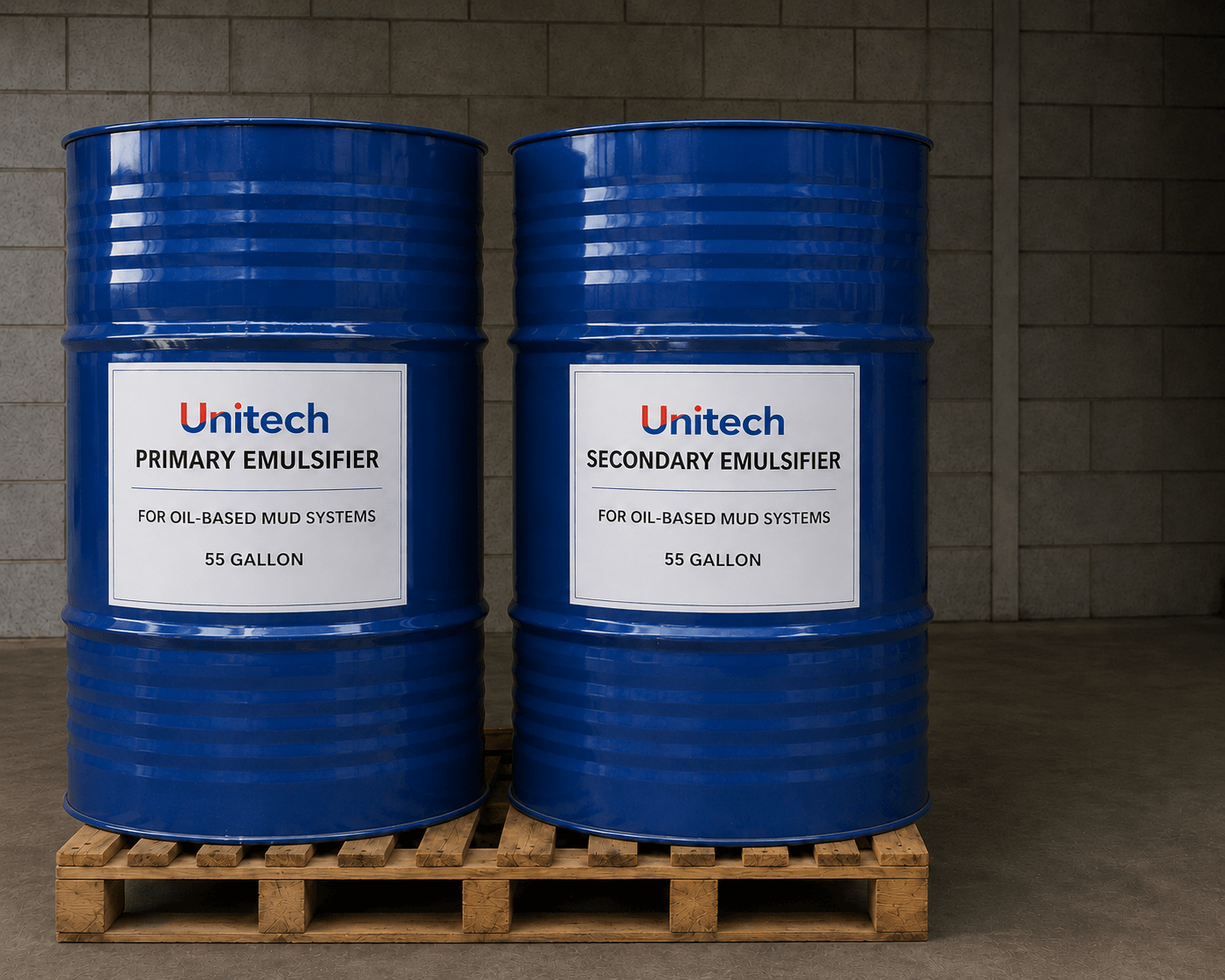
Oil-based muds require emulsifiers to stabilize the water-in-oil emulsion system.
Primary emulsifiers and secondary emulsifiers are normally used as part of an integrated emulsifier system rather than as completely independent additives.
Functions:
· Establish stable emulsions
· Improve electrical stability
Benefits:
· Strengthen emulsion systems
· Enhance temperature resistance
Applications:
· Deepwater drilling
· HPHT wells
· Challenging shale formations
Corrosion inhibitors protect:
· Drill pipe
· Casing
· Surface equipment
Common types include:
· Amine-based inhibitors
· Film-forming inhibitors
· Oxygen scavengers for controlling dissolved oxygen-related corrosion
Biocides prevent microbial degradation of polymers and organic additives.
Benefits:
· Longer fluid life
· Improved system stability
· Reduced maintenance costs
Chemical / Additive | Main Function | Typical Mud System |
Bentonite | Viscosity and suspension | WBM |
PAC | Fluid loss and rheology control | WBM |
CMC | Fluid loss control | WBM |
Xanthan Gum | Low-shear rheology and suspension | WBM |
Modified Starch | Fluid loss control | WBM |
KCl | Shale inhibition | WBM |
PHPA | Shale encapsulation | WBM |
Polyamine | Shale inhibition | WBM |
Barite | Density control | WBM / OBM |
Calcium Carbonate | Bridging / weighting / reservoir applications | WBM / OBM |
Lignosulfonate | Rheology control | WBM |
Lignite | Rheology / filtration control | WBM / OBM |
Primary Emulsifier | Emulsion stability | OBM |
Secondary Emulsifier | Emulsion strengthening | OBM |
Organophilic Clay | Rheology control | OBM |
Wetting Agent | Oil-wetting and solids dispersion | OBM |
Lime | Alkalinity / emulsification support | OBM |
Choosing the right drilling fluid additives depends on multiple operational factors:
Consider:
· Shale reactivity
· Permeability
· Mineral composition
· Formation pressure
Evaluate:
· Temperature
· Depth
· Well trajectory
· Offshore or onshore conditions
Increasingly strict regulations require:
· Low-toxicity additives
· Biodegradable products
· Environmentally acceptable lubricants
An optimal drilling fluid program balances:
· Performance
· Operational reliability
· Environmental compliance
· Overall drilling cost
Additive / Material | WBM | OBM |
Bentonite | Common | Not typically used in conventional form |
PAC | Common | Not typically used |
CMC | Common | Not typically used |
KCl | Common | Used in selected systems |
PHPA | Common | Not typically used |
Barite | Common | Common |
Calcium Carbonate | Common | Common |
Lubricants | Common | Common |
Emulsifiers | Not typically required | Essential |
Lime | Common in selected systems | Common |
Organophilic Clay | Not typical | Common |
The drilling fluid industry continues to evolve toward:
Growing demand for:
· Biodegradable polymers
· Low-toxicity lubricants
· Sustainable drilling fluid systems
As wells become deeper, additives must withstand:
· Higher temperatures
· Higher pressures
· More complex drilling conditions
New-generation polymers offer:
· Better shale inhibition
· Improved filtration control
· Enhanced thermal stability
Real-time monitoring technologies allow operators to optimize chemical treatment programs and improve drilling efficiency.
Drilling fluid additives and chemicals are fundamental to successful drilling operations. From viscosifiers and fluid loss reducers to shale inhibitors, weighting agents, lubricants, and emulsifiers, each additive contributes to maintaining wellbore stability, improving drilling efficiency, and reducing operational risks.
Selecting the appropriate drilling fluid chemicals requires a thorough understanding of formation conditions, drilling objectives, environmental requirements, and cost considerations. By combining the right additives into a properly engineered drilling fluid system, operators can maximize drilling performance while minimizing non-productive time and overall well costs.
For modern oil and gas drilling projects, partnering with an experienced drilling fluid additive manufacturer can help ensure optimal fluid design, regulatory compliance, and reliable field performance throughout the drilling process.
Unitech Chemicals is a professional manufacturer and supplier of drilling fluid additives and oilfield chemicals, serving drilling contractors, oilfield service companies, and fluid service providers worldwide.
Our product portfolio covers a wide range of drilling fluid solutions, including:
· Polyanionic Cellulose (PAC)
· Carboxymethyl Cellulose (CMC)
· Xanthan Gum
· Hydroxypropyl Modified Starch
· Shale Inhibitors
· Lubricants
· Lost Circulation Materials (LCM)
· Fluid Loss Control Additives
· Customized Drilling Fluid Chemicals
Our products are designed for both Water-Based Mud (WBM) and Oil-Based Mud (OBM) systems and are widely used in oil & gas drilling, geothermal drilling, HDD, mining, and water well applications.
At Unitech Chemicals, we believe that drilling fluid performance starts with manufacturing consistency.
Our commitment includes:
✔ Stable production capacity
✔ Strict batch-to-batch consistency
✔ Comprehensive laboratory testing and quality verification
✔ ISO-certified quality management systems
✔ Export-oriented packaging and logistics solutions
✔ Reliable global supply capability
From raw material control to finished product inspection, every stage of production is monitored to ensure product quality, stability, and long-term field performance.
As environmental regulations become increasingly important worldwide, Unitech Chemicals continues to invest in environmentally responsible drilling fluid technologies.
Our development focus includes:
· Environmentally friendly additives
· Sustainable drilling solutions
· Low-toxicity drilling fluid systems
· High-performance water-based drilling fluids
· Reduced environmental impact formulations
These solutions help operators meet both performance objectives and environmental compliance requirements.
More than simply supplying chemicals, Unitech Chemicals works closely with customers to provide technical support, product recommendations, and application guidance for challenging drilling environments.
Whether your project involves conventional drilling, shale formations, high-temperature wells, or complex geological conditions, our team is committed to delivering:
· Responsible Manufacturing
· Stable Quality Control
· International Supply Capability
· Technical Service Support
· Long-Term Partnership