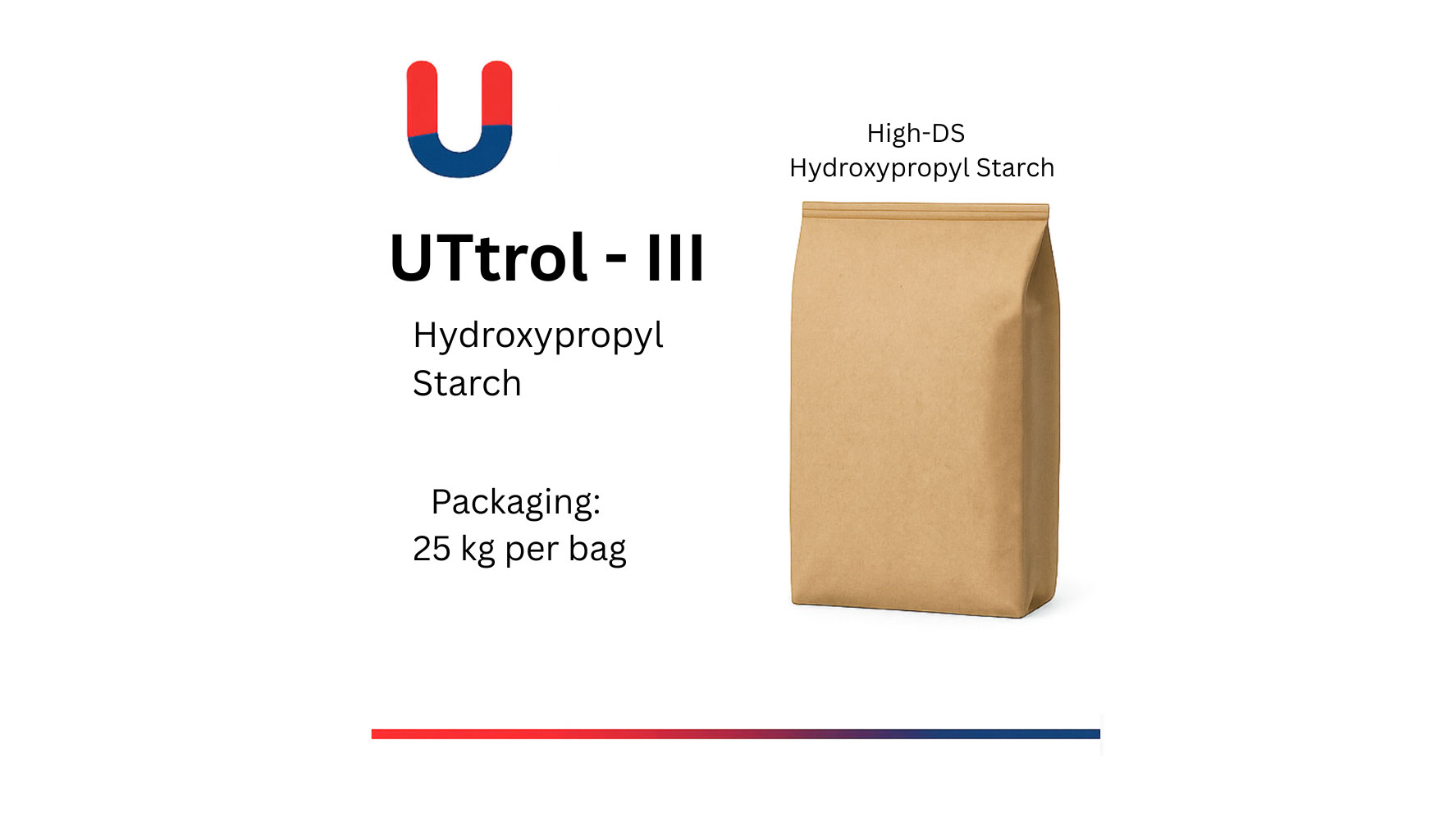
Hydroxypropyl starch is a nonionic modified starch used primarily as a fluid-loss-control additive in water-based drilling fluids. It helps reduce filtrate loss by contributing to filter-cake formation and can also influence low-shear-rate rheology and suspension performance.
In oilfield applications, hydroxypropyl starch is commonly referred to as HP starch or HPS. Its performance depends on factors such as the degree of substitution, molecular characteristics, temperature, salinity, concentration, and compatibility with other drilling fluid additives.
For drilling fluid applications, hydroxypropyl starch should be evaluated as an oilfield fluid-loss-control additive, rather than simply as a general modified starch. The same material name may also be used in food and other industrial applications, but drilling-grade products are designed and evaluated according to the performance requirements of oilfield fluid systems.
Quick Answer
What is hydroxypropyl starch in drilling fluids?
Hydroxypropyl starch is a chemically modified, nonionic starch used in water-based drilling fluids primarily for fluid-loss control. Depending on the product grade and formulation, it can also contribute to low-shear-rate viscosity and suspension performance.
What does hydroxypropyl starch do in drilling fluids?
Its primary function is fluid-loss control. It helps reduce filtrate invasion by contributing to the formation of a relatively low-permeability filter cake. In properly formulated systems, it may also support low-shear rheology and solids suspension.
Is hydroxypropyl starch suitable for high-temperature drilling?
The answer depends on the specific grade and drilling fluid formulation. High-temperature performance should be evaluated using the product's actual specifications and laboratory testing under conditions representative of the target drilling environment.
What is HP starch in drilling fluids?
HP starch is a common abbreviation for hydroxypropyl starch. In oilfield applications, it is primarily used as a starch-based fluid-loss-control additive in drilling, completion, and workover fluid systems.
1. What Is Hydroxypropyl Starch?
Hydroxypropyl starch is a modified starch derivative produced by introducing hydroxypropyl groups into the starch structure. This chemical modification changes the behavior of the original starch in aqueous systems and allows the material to be engineered for specific application requirements.
For drilling fluid applications, the purpose of modification is not simply to increase viscosity. A properly designed hydroxypropyl starch can provide filtration control while maintaining a suitable rheological profile.
Its performance can be affected by several characteristics, including:
· Degree of substitution
· Molecular structure
· Molecular weight and distribution
· Hydration behavior
· Thermal stability
· Salt tolerance
· Interaction with bentonite and other solids
· Compatibility with other polymers
· Concentration in the drilling fluid
For drilling-fluid applications, the generic material name alone is not sufficient for product selection. Performance should be evaluated under the temperature, salinity, filtration, and rheological conditions expected in the target drilling system.
2. Why Is Hydroxypropyl Starch Used in Drilling Fluids?
Water-based drilling fluids must maintain a balance between filtration control, rheology, suspension, wellbore stability, and formation protection.
Excessive fluid loss can allow the liquid phase of the drilling fluid to invade permeable formations. This may contribute to formation damage, alter near-wellbore conditions, and affect the properties of the drilling fluid system.
Hydroxypropyl starch is therefore used primarily for filtration control, while its interaction with other polymers and solids can also influence rheology and suspension.
2.1 Fluid-Loss Control
The primary role of hydroxypropyl starch in drilling fluids is to reduce filtrate loss.
When hydrated in a water-based drilling fluid, the polymer interacts with the aqueous phase and dispersed solids. During filtration, these components contribute to filter-cake development at the formation or filter-medium surface.
A properly formed filter cake can reduce permeability and slow the movement of the liquid phase into the formation.
The effectiveness of fluid-loss control depends on the complete formulation, including:
· Polymer concentration
· Polymer hydration
· Bentonite and solids concentration
· Particle-size distribution
· Salinity
· Temperature
· Pressure
· Filter-cake structure
For this reason, a fluid-loss additive should be evaluated as part of the complete drilling fluid system rather than as an isolated material.
2.2 Low-Shear-Rate Rheology
Hydroxypropyl starch can also influence drilling fluid rheology, particularly when used with other polymers.
Low-shear-rate viscosity is important when circulation slows or stops because the drilling fluid must maintain sufficient structure to suspend weighting materials and drilled solids.
The objective is not simply to maximize viscosity. A suitable drilling fluid should maintain adequate low-shear structure while remaining sufficiently fluid under circulation conditions.
The contribution of hydroxypropyl starch depends on its grade, concentration, hydration behavior, and interaction with other polymers and solids in the system.
2.3 Suspension Performance
Adequate suspension is important during low-rate circulation and static periods.
If the drilling fluid does not maintain sufficient low-shear structure, weighting materials and drilled cuttings may settle. Excessive structure, however, can increase pumping requirements and affect circulation.
Therefore, drilling fluid design needs to balance:
· Suspension
· Cuttings transport
· Pumpability
· Equivalent circulating density
· Filtration control
· Flow behavior
This is one reason hydroxypropyl starch is often evaluated together with xanthan gum and other rheology-modifying additives.
3. How Does Hydroxypropyl Starch Control Fluid Loss?
The fluid-loss-control mechanism can be simplified as:
Hydration → polymer-solids interaction → filter-cake development → reduced cake permeability → reduced filtrate invasion
After hydration, the polymer interacts with the aqueous phase and dispersed solids in the drilling fluid. During filtration, these components accumulate at the formation or filter-medium surface and contribute to the development of the filter cake.
A desirable filter cake should provide effective filtration control without excessive thickness or permeability.
The actual performance depends on the interaction between the polymer and the complete drilling fluid formulation.
For this reason, laboratory evaluation may consider:
· API fluid loss
· HTHP fluid loss
· Filter-cake thickness
· Filter-cake permeability
· Rheological properties
· Aging stability
· Salinity tolerance
A reduction in fluid loss should therefore be evaluated together with filter-cake quality and the overall rheological behavior of the drilling fluid.
4. Hydroxypropyl Starch and Drilling Fluid Rheology
One important characteristic of a hydroxypropyl starch product is its effect on rheology at low shear rates.
During active circulation, drilling fluids experience different shear conditions throughout pumps, drill pipe, drill collars, and the annulus. When circulation slows or stops, the fluid needs sufficient structure to maintain solids suspension.
This creates an important formulation objective:
The drilling fluid needs sufficient low-shear structure without creating excessive viscosity under circulation conditions.
Hydroxypropyl starch can contribute to this balance, particularly when combined with compatible polymers such as xanthan gum.
However, the resulting rheology should be measured rather than assumed. Polymer concentration, hydration, temperature, salinity, clay content, and polymer-polymer interactions can all affect the final rheological profile.
Relevant measurements may include:
· Plastic viscosity
· Yield point
· Low-shear-rate viscosity
· Gel strength
· Shear-thinning behavior
A hydroxypropyl starch used for fluid-loss control should therefore be evaluated according to both its filtration performance and its effect on the overall rheology of the drilling fluid.
5. Hydroxypropyl Starch and Xanthan Gum
Hydroxypropyl starch and xanthan gum can perform complementary functions in some water-based drilling fluid formulations.
Xanthan gum is widely used for rheological control because of its shear-thinning behavior and ability to contribute to suspension. Hydroxypropyl starch, meanwhile, is primarily used for filtration control while also influencing low-shear rheology.
When the two polymers are used together, the objective is not necessarily to maximize the concentration of either material. Instead, the formulation should be optimized for the required combination of:
· Fluid-loss control
· Low-shear-rate viscosity
· Suspension
· Flow behavior
· Pumpability
· Temperature stability
The exact interaction depends on the drilling fluid composition and operating conditions. Compatibility and dosage should therefore be confirmed through laboratory testing.
For UTtrol-II, Unitech specifically describes its combination with xanthan gum as providing a synergistic effect that improves low-shear-rate viscosity and static suspension capacity while maintaining pseudoplastic behavior during circulation.
6. Hydroxypropyl Starch and Salt Resistance
Salinity is an important consideration when selecting polymers for water-based drilling fluids.
Drilling fluids may encounter:
· Sodium chloride
· Formation brines
· Calcium ions
· Magnesium ions
· Other dissolved salts
Ionic conditions can affect polymer hydration, polymer-solids interactions, and overall rheology.
Hydroxypropyl starch products are therefore not interchangeable simply because they share the same generic chemical name. Different degrees of modification and molecular structures can result in different salt-response characteristics.
Salt resistance should therefore be treated as a product-specific performance characteristic, rather than an inherent property of every hydroxypropyl starch grade.
For field applications, the selected grade should be tested under the expected salinity and temperature conditions of the drilling fluid system.
7. Hydroxypropyl Starch vs. Conventional Starch
Native starch and hydroxypropyl starch are not equivalent drilling-fluid materials.
Native starch is an unmodified carbohydrate polymer, while hydroxypropyl starch has undergone chemical modification to change its functional behavior.
Property | Native Starch | Hydroxypropyl Starch |
Chemical modification | No | Yes |
Fluid-loss application | Possible | Commonly used |
Hydration behavior | Depends on starch type | Modified for targeted performance |
Salt response | Variable | Grade-dependent |
Rheological contribution | Variable | Grade-dependent |
Oilfield applications | Possible | Drilling, completion and workover applications |
The advantage of modified starch is not simply that it is “stronger” than native starch. Its key advantage is that its properties can be adjusted through chemical modification and product design.
Selection should therefore be based on actual performance requirements rather than assuming that all modified starch products behave the same way.
8. Hydroxypropyl Starch vs. PAC and CMC
Hydroxypropyl starch is one of several polymer families used for fluid-loss control in water-based drilling fluids.
Other commonly used materials include:
· Polyanionic cellulose (PAC)
· Carboxymethyl cellulose (CMC)
· Modified starches
· Synthetic polymer fluid-loss additives
The choice between these materials depends on the drilling fluid system and operating conditions.
Factor | Hydroxypropyl Starch | PAC / CMC |
Polymer family | Modified starch | Cellulose derivatives |
Primary role | Fluid-loss control | Fluid-loss control and/or rheology |
Low-shear rheology | Grade-dependent | Grade-dependent |
Salt response | Grade-dependent | Grade-dependent |
Temperature performance | Product-specific | Product-specific |
Compatibility | Must be evaluated | Must be evaluated |
Selection basis | System testing | System testing |
The choice between hydroxypropyl starch, PAC, CMC, or a synthetic polymer should be based on the required filtration, rheology, temperature, salinity, and formation-compatibility targets rather than the polymer family alone.
9. Applications of Hydroxypropyl Starch in Oilfield Fluids
Hydroxypropyl starch can be considered for several water-based oilfield fluid applications.
9.1 Water-Based Drilling Fluids
Water-based drilling fluids are the primary application area for hydroxypropyl starch.
Potential objectives include:
· Reducing filtrate loss
· Improving filter-cake quality
· Supporting suspension
· Managing low-shear rheology
· Maintaining system stability
The appropriate grade should be selected according to the temperature, salinity, filtration requirements, and rheological targets of the drilling system.
9.2 Reservoir Drilling Fluids
Reservoir drilling requires particular attention to filtrate invasion and potential formation damage.
When hydroxypropyl starch is combined with appropriate bridging agents or weighting particles, the resulting drilling fluid can be designed to control fluid loss while limiting unnecessary reservoir invasion.
However, formation compatibility should always be evaluated under the specific reservoir conditions.
Relevant considerations include:
· Formation permeability
· Pore-throat size
· Filtrate compatibility
· Filter-cake properties
· Potential formation damage
9.3 Completion Fluids
Hydroxypropyl starch can also be considered for certain completion-fluid formulations where filtration control and fluid properties need to be managed.
Suitability depends on factors such as:
· Brine composition
· Temperature
· Solids content
· Filtration requirements
· Compatibility with other completion-fluid additives
9.4 Workover Fluids
Workover operations may require fluid systems that provide controlled filtration while maintaining suitable rheological and suspension properties.
Hydroxypropyl starch can be considered where its performance characteristics match the requirements of the workover fluid system.
10. How to Select Hydroxypropyl Starch for Drilling Fluids
Selecting a hydroxypropyl starch should start with the operating conditions rather than the product name alone.
10.1 Temperature
Determine both the normal operating temperature and the maximum expected temperature.
Laboratory aging should reflect the expected field conditions as closely as practical.
For high-temperature applications, HTHP filtration and post-aging rheological performance may be important selection criteria.
10.2 Salinity
Identify the expected concentration and type of dissolved salts.
Monovalent and divalent ions can affect polymer performance differently, so the actual brine composition should be considered.
10.3 Fluid-Loss Requirements
Define the required filtration-control target and test method.
For demanding applications, HTHP filtration testing may provide more relevant information than relying only on low-temperature API fluid-loss results.
10.4 Rheological Requirements
Evaluate:
· Plastic viscosity
· Yield point
· Low-shear-rate viscosity
· Gel strength
· Shear-thinning behavior
A fluid-loss additive should not create excessive viscosity that compromises circulation or increases unnecessary pumping requirements.
10.5 Compatibility With Other Additives
Hydroxypropyl starch may be used in systems containing:
· Xanthan gum
· PAC
· CMC
· Bentonite
· Bridging agents
· Weighting materials
· Shale inhibitors
· Lubricants
Compatibility testing is important because polymer-polymer and polymer-solid interactions can significantly affect fluid performance.
10.6 Formation Characteristics
For reservoir drilling, additional consideration should be given to:
· Formation permeability
· Pore-throat size
· Filtrate sensitivity
· Potential formation damage
· Required filter-cake properties
The selected additive should be evaluated as part of the complete reservoir drilling fluid system.
10.7 Laboratory Performance Data
For procurement and formulation decisions, it is useful to request the supplier's:
· Product specification
· Recommended test methods
· Temperature and aging conditions
· Fluid-loss data
· Rheological data
· Salt-tolerance data
· Compatibility information
Testing under conditions representative of the target drilling fluid system provides a more reliable basis for product selection than comparing generic product names alone.
11. UTtrol-II Hydroxypropyl Starch for Drilling Fluids
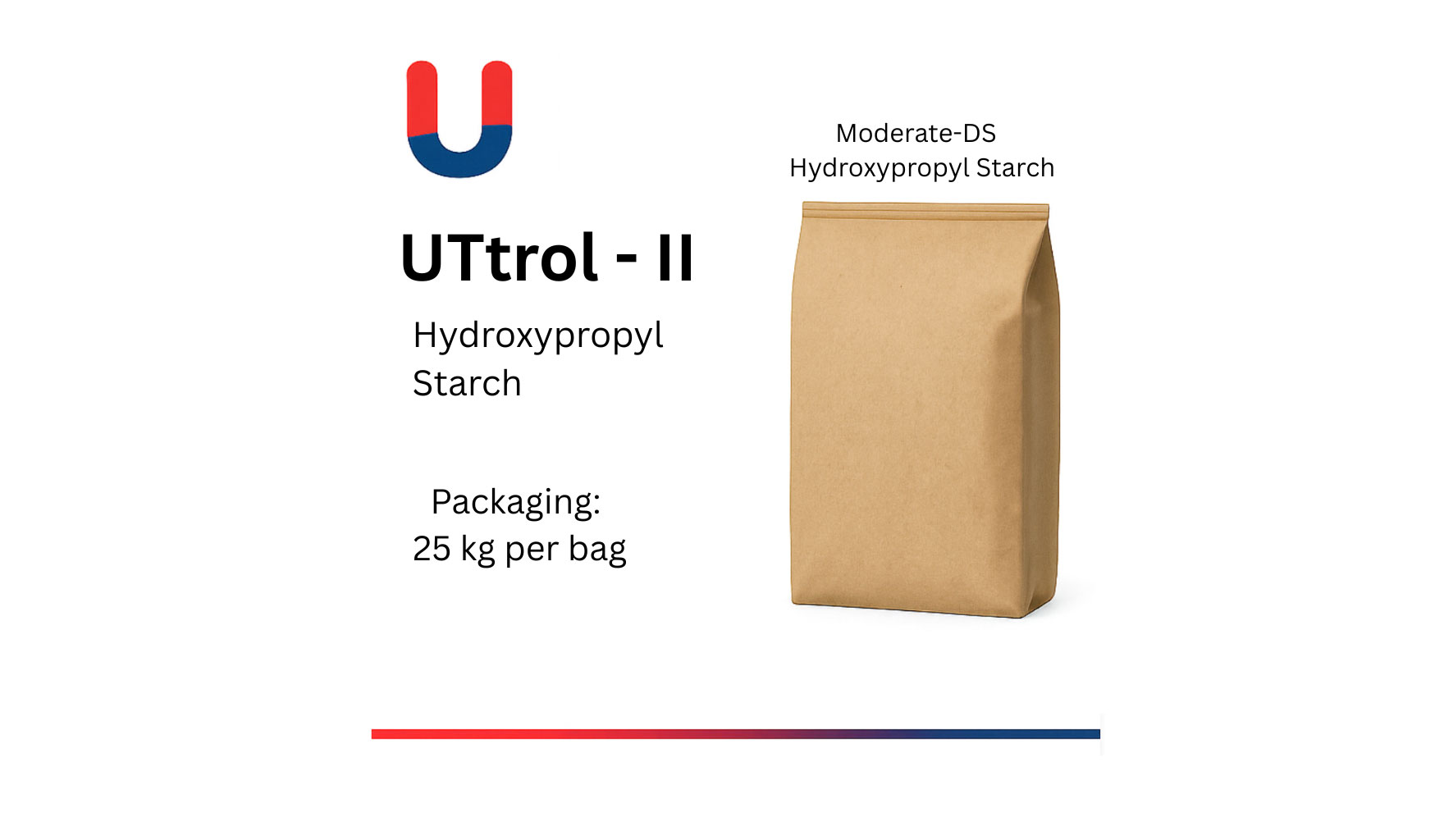
UTtrol-II is a hydroxypropyl starch with a moderate degree of substitution, developed for use as a fluid-loss-control additive in oilfield drilling fluids.
According to Unitech's product specification, UTtrol-II is designed for use in:
· Oilfield drilling fluids
· Completion fluids
· Workover fluids
The product provides fluid-loss control and is described as salt resistant. When combined with xanthan gum, it can contribute to low-shear-rate viscosity and static suspension while maintaining pseudoplastic flow behavior during circulation.
For reservoir drilling applications, UTtrol-II can be combined with suitable bridging agents or weighting particles to help control fluid loss while minimizing unnecessary reservoir invasion.
Why Consider UTtrol-II?
UTtrol-II is characterized by:
· Moderate degree of substitution
· Fluid-loss-control performance
· Salt-resistant performance
· Low-shear-rate viscosity contribution when used with xanthan gum
· Application in drilling, completion, and workover fluids
Its suitability for a specific drilling fluid system should be confirmed through laboratory testing under representative operating conditions.
UTtrol-II Specifications
Item | Specification |
Appearance | White to light yellow powder |
Moisture Content | ≤12% |
Particle Size, +40 Mesh | ≤3% |
LSRV | ≥27,500 cP |
HTHP Fluid Loss | ≤20 mL |
The LSRV specification is based on Brookfield DV II testing after hot rolling at 150°F (66°C) for 4 hours, followed by cooling to 77°F (25°C) before testing.
The HTHP fluid-loss specification is measured at 250°F (121°C) and 500 psi for 30 minutes.
These test conditions should be considered when comparing products because fluid-loss and rheological results can vary significantly with temperature, pressure, aging conditions, formulation, and test method.
Conclusion
Hydroxypropyl starch is a modified starch polymer used primarily for fluid-loss control in water-based drilling fluids. Depending on the product grade and formulation, it can also contribute to low-shear-rate rheology and suspension performance.
Selecting the appropriate grade requires consideration of temperature, salinity, filtration requirements, rheological targets, additive compatibility, and formation characteristics. Product specifications should be evaluated together with laboratory testing under conditions representative of the target drilling fluid system.
UTtrol-II is a hydroxypropyl starch with a moderate degree of substitution for drilling, completion, and workover fluids. It provides fluid-loss-control and salt-resistant performance and can contribute to low-shear-rate viscosity and suspension when formulated with xanthan gum.
For product specifications, compatibility testing, or application support, contact Unitech Chemical to discuss your drilling fluid requirements.
Frequently Asked Questions About Hydroxypropyl Starch in Drilling Fluids
Is hydroxypropyl starch used in drilling fluids?
Yes. Hydroxypropyl starch is used as a modified starch-based additive in water-based drilling fluids, particularly for fluid-loss control. Its performance depends on the specific grade and drilling fluid formulation.
What does hydroxypropyl starch do in drilling fluid?
Its primary function is fluid-loss control. Depending on the product grade and formulation, it can also contribute to low-shear-rate viscosity and suspension performance.
What is HP starch in drilling fluids?
HP starch is a common abbreviation for hydroxypropyl starch. In oilfield applications, it is primarily used as a starch-based fluid-loss-control additive.
What is the difference between hydroxypropyl starch and PAC?
Both can be used for fluid-loss control, but they belong to different polymer families and can behave differently with respect to rheology, salinity, temperature, and compatibility. Selection should be based on the complete drilling fluid formulation and laboratory performance.
Can hydroxypropyl starch be used with xanthan gum?
Yes. Hydroxypropyl starch can be formulated with xanthan gum in some water-based drilling fluid systems. The combination can be designed to balance fluid-loss control, low-shear rheology, suspension, and circulation behavior.
Is hydroxypropyl starch suitable for reservoir drilling?
It can be used in reservoir drilling fluid systems where its filtration-control and rheological characteristics are appropriate. Formation compatibility, bridging-material selection, and potential formation damage should be evaluated for the specific reservoir.
How should hydroxypropyl starch be selected?
Consider temperature, salinity, filtration requirements, rheological targets, compatibility with other additives, formation characteristics, and laboratory performance. Supplier specifications and test data should be evaluated under conditions representative of the target drilling fluid system.