

An oil-based mud (OBM) wetting agent is a surface-active chemical used to convert and maintain drilled solids, barite, and other weighting materials in an oil-wet state. Wetting agents improve solids dispersion, reduce barite sag, stabilize rheology, and enhance overall drilling fluid performance. Unlike emulsifiers, which stabilize water droplets within the oil phase, wetting agents primarily act on solid particle surfaces to ensure compatibility with the oil-continuous system.
A wetting agent is a specialized additive used in invert emulsion and oil-based drilling fluids to alter the surface characteristics of solids.
In an oil-based mud system, the continuous phase is oil. For the system to remain stable, drilled solids, barite, and other weighting materials must remain preferentially wetted by oil rather than water.
The primary role of a wetting agent is to:
· Convert water-wet solids into oil-wet solids
· Maintain oil-wet surfaces under drilling conditions
· Improve solids dispersion
· Reduce rheology problems caused by poorly wetted solids
· Help prevent barite sag and settling
A wetting agent is a surface-control additive that modifies the surface energy of solids, enabling stable dispersion within the oil phase of an oil-based drilling fluid.
Oil-based mud performance depends heavily on maintaining an oil-wet environment.
When solids become partially water-wet, the entire drilling fluid system may become unstable.
Poorly wetted barite particles tend to agglomerate and settle, causing density variations throughout the fluid system.
Potential consequences include:
· Inconsistent mud weight
· Well control risks
· Increased non-productive time (NPT)
Water-wet solids interact more strongly with each other, leading to:
· Increased plastic viscosity (PV)
· Elevated yield point (YP)
· Higher pump pressure requirements
Agglomerated solids reduce fluid uniformity and filtration performance.
Although wetting agents are not emulsifiers, poor oil-wetting often contributes to emulsion stress and reduced overall fluid stability.
In directional and horizontal wells, poorly dispersed solids can increase friction and mechanical resistance.
Water-wet solids → Agglomeration → Poor dispersion → High rheology → Barite sag → Reduced drilling efficiency
Wetting agents function by adsorbing onto solid surfaces and altering their affinity for oil and water.
Most oilfield wetting agents contain molecules with:
· Oil-soluble hydrocarbon chains
· Polar functional groups capable of interacting with solid surfaces
After adsorption:
· Surface energy is reduced
· Oil affinity increases
· Water affinity decreases
· Solids become more easily dispersed within the oil phase
· Improved oil-wetting of solids
· Better suspension stability
· Reduced particle aggregation
· Enhanced rheology control
· Lower sag tendency
Wetting agents stabilize the solid phase of the drilling fluid, while emulsifiers stabilize the liquid-liquid interface.
Wetting agents and emulsifiers are often confused because both are surface-active additives. However, they serve different functions.
Parameter | Wetting Agent | Emulsifier |
Primary Target | Solid particles | Water droplets |
Main Purpose | Surface wettability | Emulsion stability |
Function | Maintain oil-wet solids | Maintain water-in-oil emulsion |
Primary Benefit | Solids dispersion and sag control | Emulsion integrity |
Typical Failure Indicator | Water-wet solids, sag | Low electrical stability (ES) |
Main Performance Area | Solids control | Interface control |
· Emulsifiers stabilize droplets.
· Wetting agents stabilize solids.
Most high-performance OBM systems require both.
Derived from natural or synthetic fatty acids.
Advantages:
· Strong oil affinity
· Good solids wetting performance
· Cost-effective
Provide strong adsorption on solid surfaces.
Advantages:
· Excellent thermal stability
· Strong oil-wetting capability
· Suitable for demanding drilling conditions
Widely used in invert emulsion drilling fluids.
Advantages:
· Effective barite wetting
· Good compatibility with emulsifier systems
· Useful in high-density mud systems
Field indicators often appear before major drilling fluid problems develop.
Cuttings adhere to shaker screens and equipment surfaces.
Barite fails to disperse properly and may form aggregates.
Increased friction can indicate poor solids conditioning.
Unexpected increases in PV and YP may result from poor solids wetting.
Static or dynamic sag often indicates inadequate wetting performance.
Poorly conditioned solids can contribute to filter cake quality issues.
Oil-wetting problems often become more severe under high-temperature conditions.
· Insufficient wetting agent concentration
· Poor solids dispersion
· High-density mud formulation
· Evaluate wetting agent treatment level
· Improve solids conditioning
· Verify rheology balance
· Water-wet solids
· Solids agglomeration
· Inadequate surface treatment
· Increase wetting efficiency
· Improve solids dispersion
· Rebalance fluid formulation
· Incompatible additive package
· Insufficient wetting capacity
· Review additive compatibility
· Optimize wetting agent concentration
· Contamination
· High solids loading
· Wetting agent depletion
· Restore oil-wetting capacity
· Remove excessive solids
· Monitor contamination sources
· Thermal degradation of additive system
· Increased solids interaction under heat
· Use thermally stable wetting agents
· Evaluate HTHP fluid performance through laboratory testing
Different OBM formulations require different wetting characteristics.
Consider:
· Diesel-based mud
· Mineral oil-based mud
· Synthetic-based mud
Higher mud weights generally require stronger solids wetting performance.
High solids systems typically require greater wetting capacity.
For deep and HTHP wells, thermal stability becomes critical.
Evaluate:
· Long-term heat resistance
· Compatibility under aging conditions
Regional regulations may influence additive selection and discharge requirements.
In high-temperature wells, wetting performance becomes increasingly important.
Elevated temperatures may:
· Increase solids interaction
· Accelerate additive degradation
· Increase sag risk
For HTHP applications:
· Select thermally stable wetting agents
· Conduct hot rolling tests
· Monitor rheology retention
· Evaluate sag resistance under aging conditions
· High-Temperature High-Pressure (HTHP) Drilling Fluid Stability Guide
· Oil-Based Mud Emulsifier System Design Guide
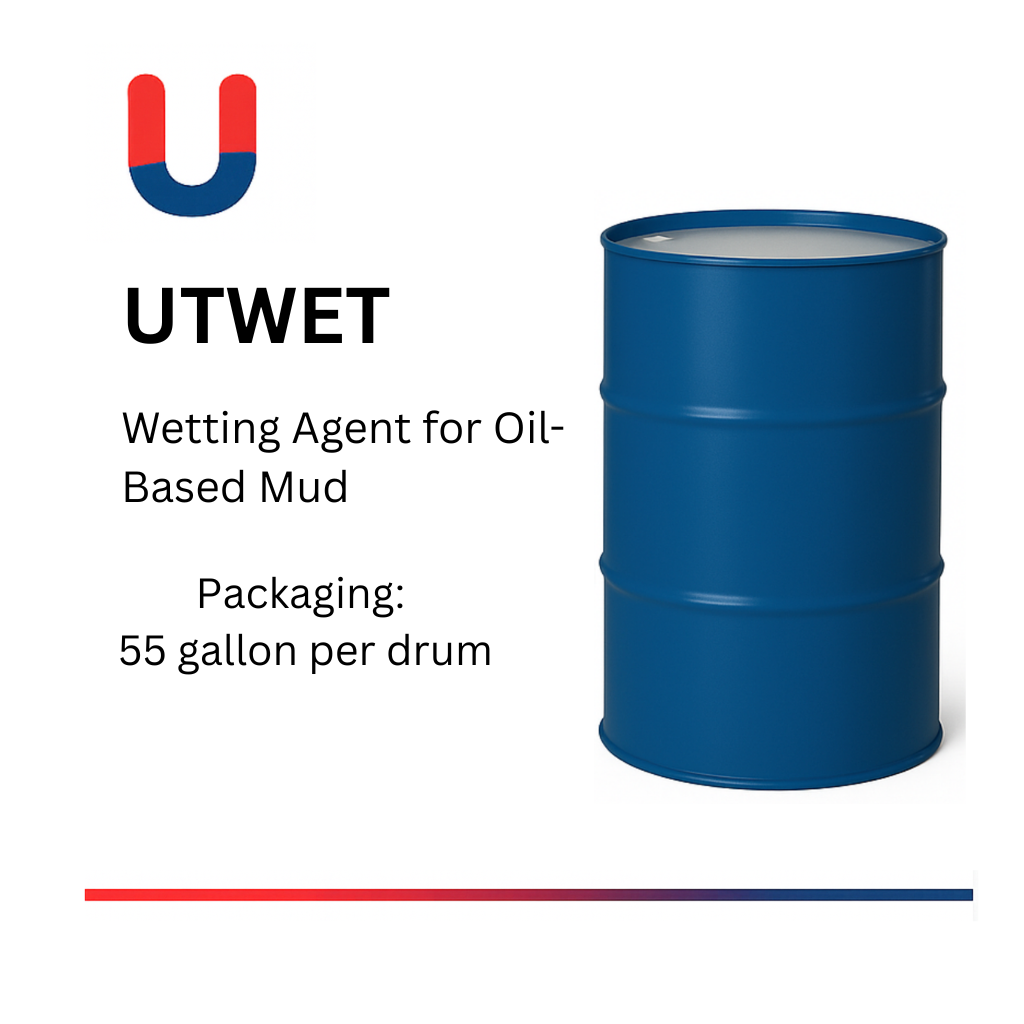
UTwet is a high-performance oil wetting agent specifically designed for oil-based and invert emulsion drilling fluids.
It effectively converts originally water-wetted or dry barite, drilled solids, and weighting materials into an oil-wetted state, ensuring seamless incorporation into the oil phase.
· Excellent Oil-Wetting & Dispersion: Effectively inhibits cuttings agglomeration and prevents solid phase settlement (barite sag).
· Advanced Rheology Control: Provides a remarkable viscosity reduction and thinning effect when drill cuttings and weighting agents cause excessive mud rheology.
· High-Solids Thinning Action: Optimizes fluid stability and flow properties even in high-density, high-solids mud systems.
· Universal Compatibility: Fully compatible with most invert emulsion drilling fluid systems.
· High-density oil-based mud (OBM) systems
· High-Temperature High-Pressure (HTHP) drilling environments
· Extended reach wells (ERW)
· High solids loading drilling conditions
Property | Value |
Product Code | UTWET |
Appearance | Clear amber mobile liquid |
Odor | Slightly mineral oil |
Specific Gravity @ 20°C | 0.90 – 0.98 |
Flash Point (PMCC) | > 110°C (> 230°F) |
Pour Point | < -5°C |
Solubility | Soluble in oil; gets milky in water |
Packaging | 55-gallon per drum |
When evaluating suppliers, consider:
· Oil-wetting performance data
· Sag reduction testing
· HTHP compatibility testing
· Rheology impact studies
· Formulation optimization assistance
· Field troubleshooting experience
· Laboratory testing capability
· Can you provide HTHP performance data?
· Is the product compatible with my emulsifier system?
· Do you have field application case histories?
· Can treatment levels be optimized for my mud system?
An effective wetting agent program can:
· Reduce barite sag incidents
· Improve drilling fluid stability
· Lower chemical treatment frequency
· Improve drilling efficiency
· Reduce non-productive time (NPT)
· Extend fluid service life
Oil-based mud wetting agents play a critical role in maintaining stable solids dispersion and ensuring that drilled solids and weighting materials remain oil-wet throughout drilling operations.
Unlike emulsifiers, which stabilize water droplets, wetting agents focus on surface control of solids. Proper wetting performance helps reduce barite sag, control rheology, improve suspension stability, and enhance overall drilling fluid performance.
For modern high-density, extended-reach, and HTHP drilling operations, selecting the right wetting agent is an essential part of successful oil-based mud system design.
Maintaining proper oil-wetting is critical for achieving stable rheology, minimizing barite sag, and improving drilling performance in oil-based mud systems.
Whether you are designing a new OBM formulation or troubleshooting field performance issues, selecting the right wetting agent can significantly improve fluid stability and operational efficiency.
Unitech Chemicals provides:
· Laboratory evaluation support
· Formulation optimization services
· HTHP drilling fluid consulting
· Technical assistance for OBM systems